
Some dates arrive quietly.
Others arrive with a full orchestra.
3 March 1875 was the night Carmen premiered in Paris. Composed by Georges Bizet, it introduced audiences to a heroine who was anything but modest. Carmen is heat, defiance and independence in human form. She doesn’t drift onto the stage — she claims it.
That larger-than-life presence matters. Opera is architectural. The voice must fill space. The character must command it. Carmen is not background decoration; she is the title.
But what does that have to do with Miami Beach and a marmalade sandwich?
Quite a lot, as it turns out.
The Orange Line: Seville to Florida
Carmen is set in Seville, a city long associated with bitter oranges — the traditional fruit used in marmalade. The classic “Seville orange” became shorthand for that sharp, fragrant preserve found on British breakfast tables.
Florida, meanwhile, joined the United States on 3 March 1845. Over time it built a global reputation for citrus. Not the bitter Seville variety, but sweet oranges destined for juice glasses rather than jam jars.
Different types.
Same symbol.
Sunlight turned into fruit.
Climate turned into identity.
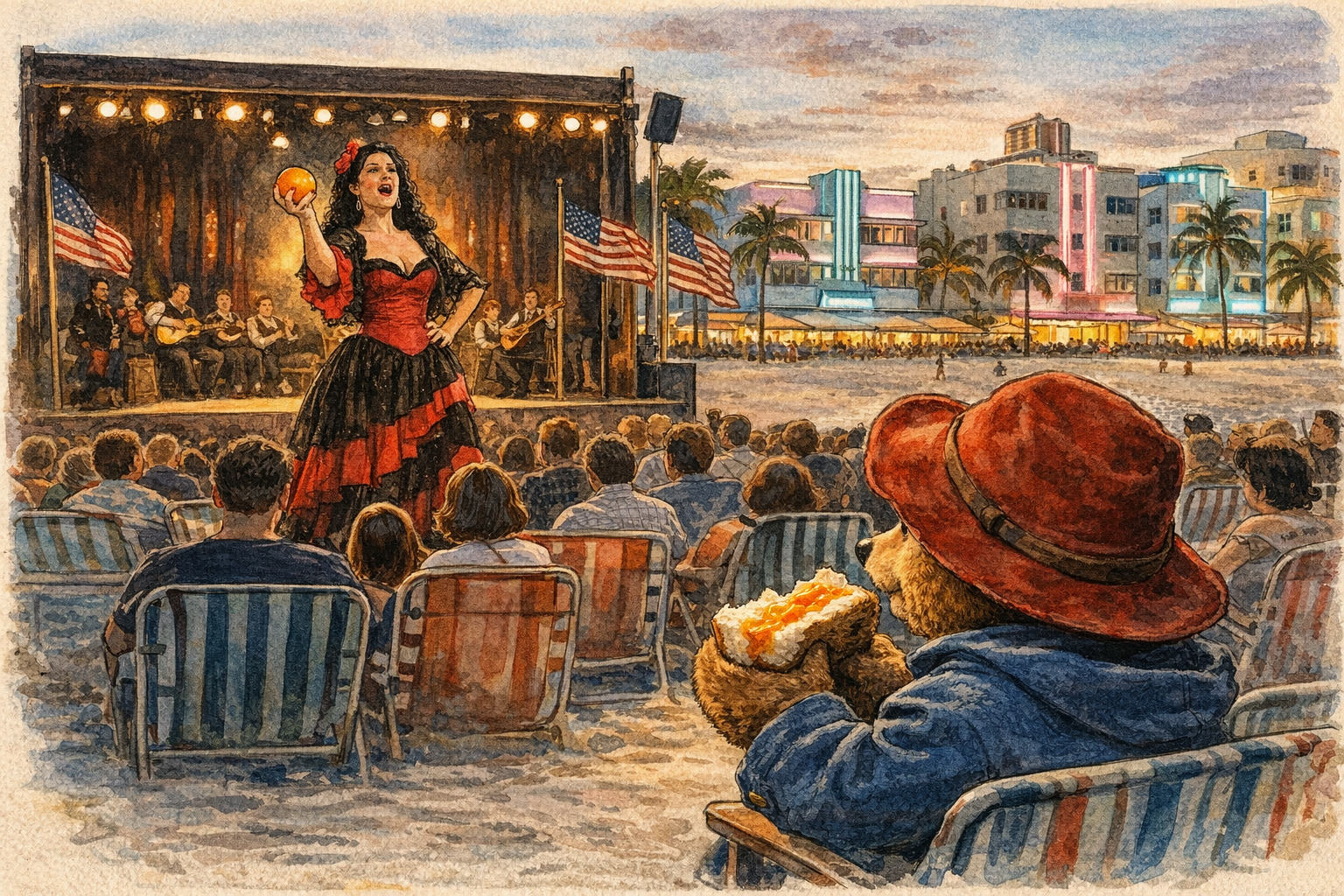
So when Carmen stands on a Miami Beach stage holding an orange, the connection is clean:
Seville → Oranges
Florida → Oranges
Miami → A meeting point of cultures shaped by sun and trade
No strain required.
Havana, Heat and Rhythm
Carmen’s most famous aria, the Habanera, draws on a Cuban dance rhythm that travelled from Havana to Spain before reaching Paris. That musical migration mirrors the cultural flow that later shaped Miami, especially in Little Havana.
Havana → Seville → Paris → Miami.
A neat circle of heat and movement.
Parisian Echoes: Love and Loss
The operatic web tightens further in Paris.
La Bohème and La Traviata are both set in the French capital. Both centre on a heroine who dies of tuberculosis. Romantic Paris, artistic Paris, tragic Paris.
In La Traviata, there is also the famous Brindisi — a sparkling drinking song celebrating pleasure before decline.
That idea of a drinking melody becoming something grander echoes across the Atlantic in the history of The Star-Spangled Banner, whose tune originated in a British club song before becoming America’s anthem. It would be formally adopted in the twentieth century — long after Florida entered the Union.
Paris opera (zoom to La Traviata, zoom again) → Drinking song
Drinking song (snap) → National anthem
Washington → Florida (zoom in) → Miami
Again, the steps remain short and steady.
A Flourishing Detail
Even the names carry botanical hints.
Florida derives from the Spanish for “flowery” or “flourishing.”
By extension, Florence comes from Latin Florentia, also meaning flourishing.
Blossom and growth sit quietly beneath the surface of these places — much like orange blossom in Seville’s spring air.
And Paddington?
In the illustration, Carmen commands the stage. Flags move in the sea breeze. Art Deco facades glow in pastel neon.
And Paddington, seated faithfully at the back, is not watching the diva at all.
He is studying his marmalade sandwich.
Which may be the most grounded detail of all.
Opera can soar.
History can loop through Paris, Havana and Washington.
Cities can flourish.
But on 3 March, the strongest line is simple:
Seville oranges → Marmalade → Florida citrus → Miami Beach.
Everything else is accompaniment.
And the bear from deepest darkest Peru, wisely, knows what matters most. 🐻🍊