
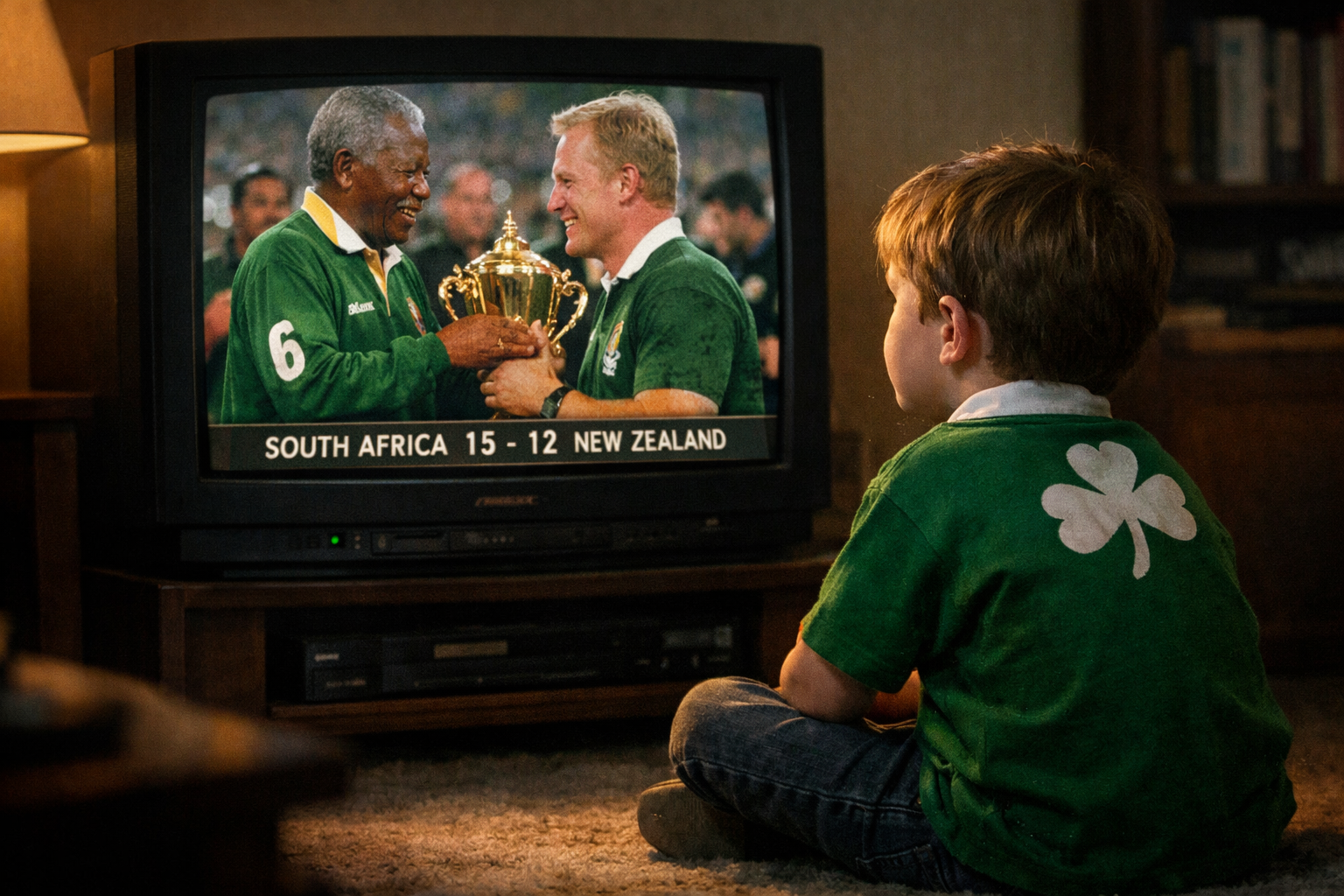
At first glance, the 17th of March feels easy.
It’s St Patrick’s Day — green everywhere, shamrocks, parades, identity worn proudly on sleeves and shirts. A day so synonymous with Ireland that it’s easy to forget it didn’t even begin there in its modern form, with the first recorded parade taking place in St Augustine, Florida, in 1601.
Green, then, is the obvious starting point.
But it’s not the most interesting one.
🇿🇦 Another 17 March — Less Celebrated, More Consequential
On 17 March 1992, something less visible — but arguably far more significant — took place.
White South Africans voted in a referendum to end apartheid.
It wasn’t the end of the story, but it was the moment when a system built on division began to dismantle itself from within. A vote, rather than a parade. No colour-coded celebration — just the beginning of a different future.
And yet, three years later, that future would also be expressed in green.
🏉 Green Reclaimed
In 1995, South Africa hosted — and won — the Rugby World Cup.
- On the pitch: the South Africa national rugby union team, wearing green.
- Opposition: the New Zealand national rugby union team, in all black.
- Score: 15–12.
But the defining image wasn’t the match itself.
It was Nelson Mandela, walking onto the field wearing the green No. 6 Springbok shirt, presenting the trophy to captain François Pienaar.
That shirt mattered.
Because before 1994, the Springbok jersey wasn’t a neutral symbol. It was associated with white South Africa — rejected by many Black South Africans as a representation of exclusion.
Mandela didn’t discard it.
He wore it.
🔄 The Inversion
This is where the colour green becomes interesting.
In Ireland, green represents one side of a historical divide — Catholic, nationalist, Gaelic identity — held in tension with orange, with white between them symbolising peace. Yet the rugby team, playing in green, represents all-Ireland.
In South Africa, green had also been tied to division.
But Mandela didn’t create a new symbol.
He reclaimed an old one.
Not:
“This belongs to us now.”
But:
“This belongs to everyone now.”
That’s a very different move.
🎶 The Musical Detour (and Why It Falls Short)
There is, of course, another way to connect Ireland and South Africa.
Music:
-
U2 – Silver and Gold → a critique of Western reluctance to impose sanctions on apartheid South Africa.
-
Simple Minds – Mandela Day → written for the 70th birthday tribute concert (via Belfast Child → linking Northern Ireland’s own divisions to a broader global context).
These are powerful songs. Important songs.
They show Ireland — and its cultural neighbours — engaging with injustice beyond their own borders.
But there is a subtle tension here.
It could be argued that these are, in part, examples of external voices speaking into someone else’s struggle — well-meaning, influential, but still at a distance.
🏉 Why Rugby Wins
The rugby image does something different.
It isn’t commentary.
It’s ownership.
Mandela, a Black South African leader, choosing to wear a symbol historically associated with white South Africa — not to erase its past, but to transform its meaning.
No performance. No interpretation.
Just a moment where:
-
the crowd sees it
-
the players feel it
-
the country recognises it
👉 The message doesn’t need explaining.
📺 A Child Watching
Now place that moment in a different room.
A modest Irish living room, 1995.
A child sits on the floor, wearing a green rugby shirt with a shamrock crest. On the television, Mandela hands the trophy to Pienaar. The score reads South Africa 15–12 New Zealand.
The child is five years old.
Born in 1990.
Too young to understand the full weight of what he’s seeing — but old enough to absorb it.
Old enough to grow up in a world where:
-
green means celebration
-
green means identity
-
green can also mean reconciliation
🎤 The Next Voice
That child grows up as the singer Hozier.
And in time, he becomes part of a generation that expresses justice differently — through music, through voice, through culture.
Not as observers.
But as inheritors.
🍀 The Real Link
So yes, it’s all green.
But not for the most obvious reason.
-
🇮🇪 In Ireland → green marks identity
-
🇿🇦 In South Africa → green is reclaimed to create unity
-
👶 In between → a generation watches, learns, and reinterprets