
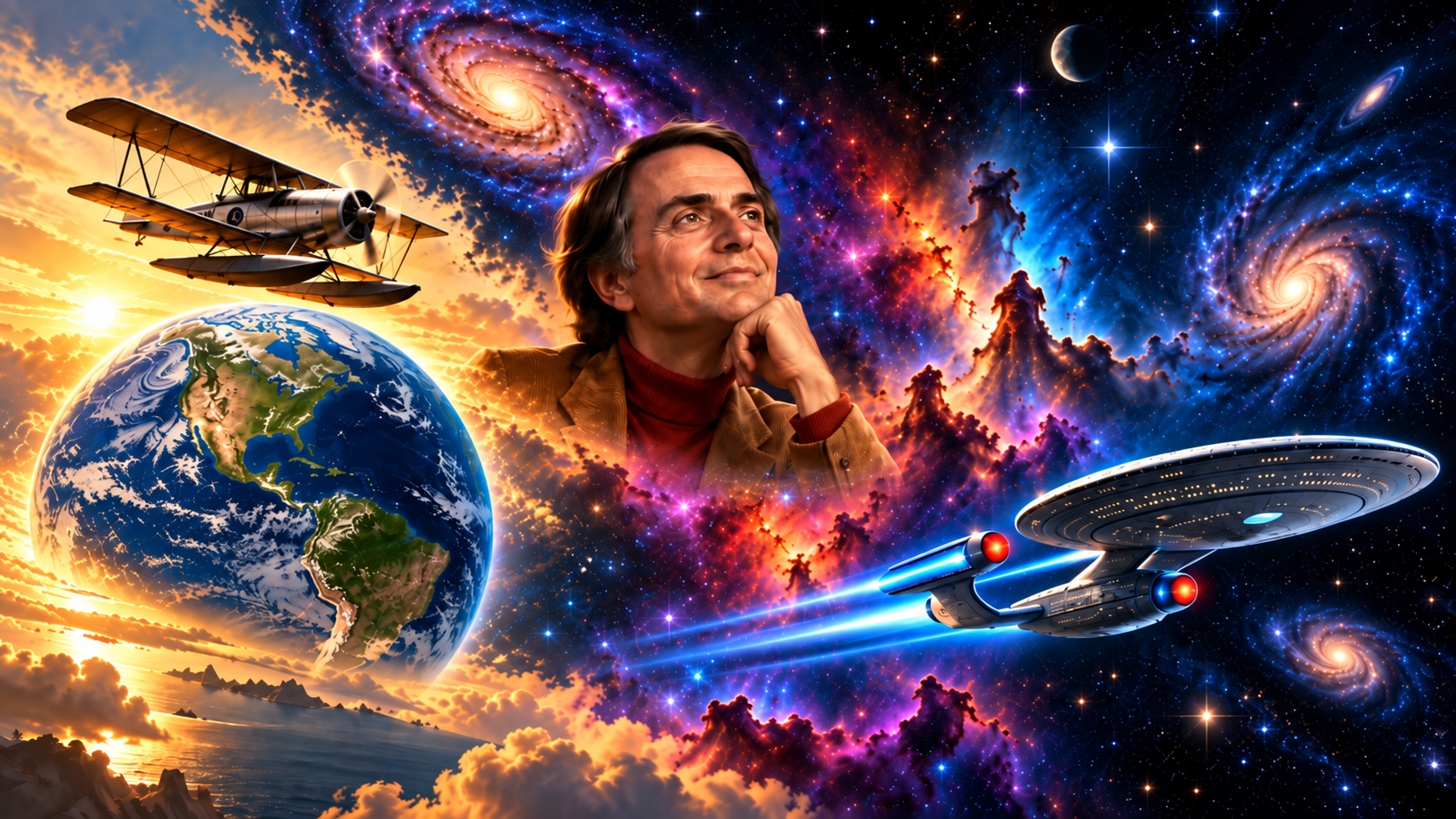
What happens when going around the world is no longer enough?
On 28 September 1924, two Douglas World Cruisers returned to Seattle and completed the first aerial circumnavigation of the globe. The US Army Air Service expedition had begun on 6 April and lasted 175 days, covering roughly 27,550 miles. Four aircraft had set out; Chicago and New Orleans completed the entire journey.
For most of human history, travelling all the way around our planet had been an extraordinary undertaking. Now it had been done by air.
WORLD → FLIGHT → CIRCUMNAVIGATION
Jump forward exactly 56 years.
On 28 September 1980, American television viewers met astronomer Carl Sagan in the first episode of Cosmos: A Personal Voyage. The 13-part series used science, history and Sagan’s “Ship of the Imagination” to take its audience far beyond a journey around Earth.
The scale had changed.
Instead of asking how we could travel around our world, Cosmos asked where that world fitted into something unimaginably larger.
EARTH → SOLAR SYSTEM → GALAXY → COSMOS
And then, seven years to the day later, television took another step.
On 28 September 1987, Star Trek: The Next Generation began with Encounter at Farpoint, introducing Captain Jean-Luc Picard and the crew of the USS Enterprise-D.
Sagan invited us to imagine the universe.
Star Trek imagined us travelling through it.
That gives 28 September a rather beautiful progression:
1924 — Around the world
✈️ The first aerial circumnavigation
1980 — Around the cosmos
🌌 Carl Sagan brings the universe into our living rooms
1987 — Across the final frontier
🖖 Star Trek: The Next Generation begins
In just 63 years, the imaginative scale moves from an aircraft struggling around one small blue planet to a starship roaming between the stars.