
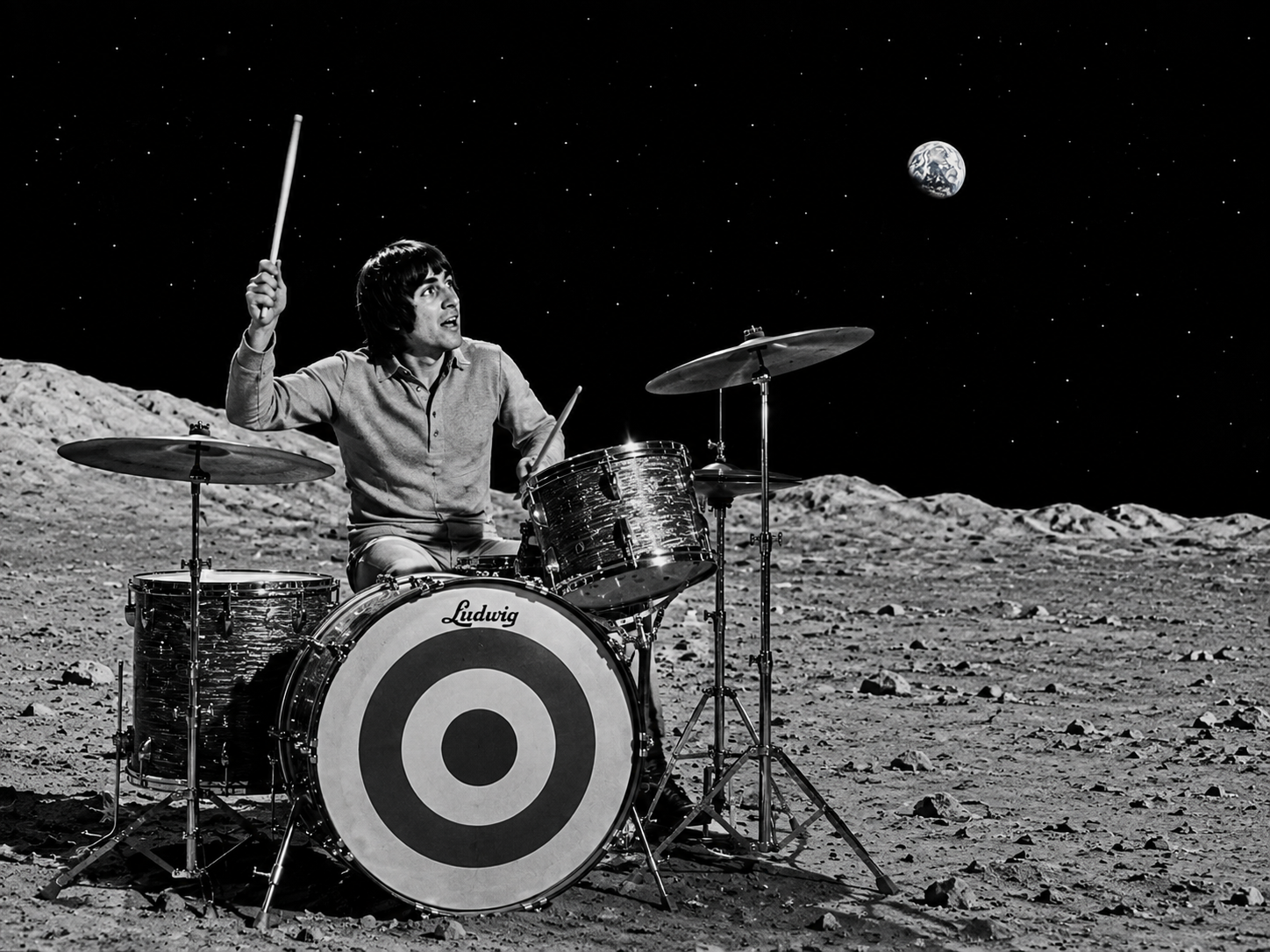
On 23 August 1946, Keith Moon was born in Wembley. Twenty years later, on 23 August 1966, NASA’s Lunar Orbiter 1 took the first photograph of Earth from the vicinity of the Moon.
So, on Keith Moon’s twentieth birthday, a camera at the Moon turned around and looked back at Earth.
Moon on the Moon.
The photograph wasn’t the first picture of Earth from space. That milestone had already been achieved using a V-2 rocket in 1946 — coincidentally, the same year Keith Moon was born. What made the Lunar Orbiter 1 image different was the enormous change in viewpoint. Instead of looking down on part of the Earth from relatively nearby, the spacecraft was looking back across hundreds of thousands of kilometres of space.
Earth had become something over there.
That gives us an almost literal demonstration of MOVE, ZOOM and SNAP.
MOVE: Earth to Moon
First, we move.
Our viewpoint travels from Earth all the way to the Moon, roughly 380,000 kilometres away. We then turn around and look homeward.
It is a geographical link on the largest possible scale. Earth is no longer the place from which the photograph is being taken. It has become the object in the photograph.
And waiting for us in the word Moon is Keith.
ZOOM: into the space-race timeline
Then we zoom — not merely with a camera lens, but into a particular moment in the history of space exploration.
The Lunar Orbiter programme was not primarily intended to produce inspirational photographs of Earth. Its job was to photograph the lunar surface and help identify potential landing sites for the Apollo missions.
So 1966 places us at a fascinating point on the timeline.
Humans have reached space. Robotic spacecraft are reaching the Moon. We can now send a camera there and photograph our own planet from lunar distance.
But nobody has yet walked on the Moon.
That breakthrough is still almost three years away. On 20 July 1969, Neil Armstrong and Buzz Aldrin will land with Apollo 11, and Armstrong will take humanity’s first step onto another world.
The Lunar Orbiter photograph therefore catches the story somewhere between two eras: we have travelled far enough to see Earth from the Moon, but not yet far enough for a human being to stand there and take the photograph.
SNAP: two stories on one date
Finally, we snap the connections together.
Back on Earth, another Moon was making plenty of noise.
By August 1966, The Who were already becoming one of Britain’s best-known young rock bands. I Can’t Explain had reached the UK Top Ten in 1965, while My Generation had reached number two. Earlier in 1966, Substitute had reached number five.
And just three days after Keith Moon’s twentieth birthday, The Who released I’m a Boy, which would also reach number two.
They weren’t yet the enormous international rock institution they would become. Tommy, Woodstock, Who’s Next and many of their defining moments were still ahead. But in Britain, The Who had very definitely arrived — and their spectacular drummer was already an essential part of their identity.
So on 23 August 1966, we can move between two very different worlds.
Far away, Lunar Orbiter 1 is circling the Moon and looking back towards Earth.
Down on Earth, Keith Moon is turning twenty while The Who are rapidly becoming famous.
Three years later, there will be a man on the Moon.
But on 23 August 1966, our Link Salad gives us something else entirely:
Moon on the Moon. 🌙🥁🌍