
What happens when a giant from an eighteenth-century novel meets one of the twentieth century’s most disturbing painters?
Today’s Link Salad celebrates the 300th anniversary of Gulliver’s Travels and the birthday of Francis Bacon. Two extraordinary figures, two different centuries, one shared date — and an unexpected connection through Dublin.
1726 — Gulliver’s Travels
On 28 October 1726, Jonathan Swift’s Gulliver’s Travels was first published in London.
The novel follows Lemuel Gulliver through a series of extraordinary voyages, beginning with his arrival in Lilliput, where the inhabitants are just six inches tall.
Finding Gulliver asleep, the Lilliputians restrain him with hundreds of tiny ropes. The image of a giant rendered helpless by miniature people has become one of the most recognisable scenes in English literature.
But Swift’s novel is much more than an adventure story. Through imaginary societies and extraordinary differences in scale, he satirised politics, human vanity and the absurdities of civilisation.
1909 — Francis Bacon
On 28 October 1909, exactly 183 years later, Francis Bacon was born in Dublin.
He became one of the twentieth century’s most influential painters, renowned for his unsettling portraits and distorted representations of the human body.
His paintings frequently portray figures trapped within confined spaces, their faces and bodies twisted into expressions of psychological tension.
Gulliver Meets Bacon
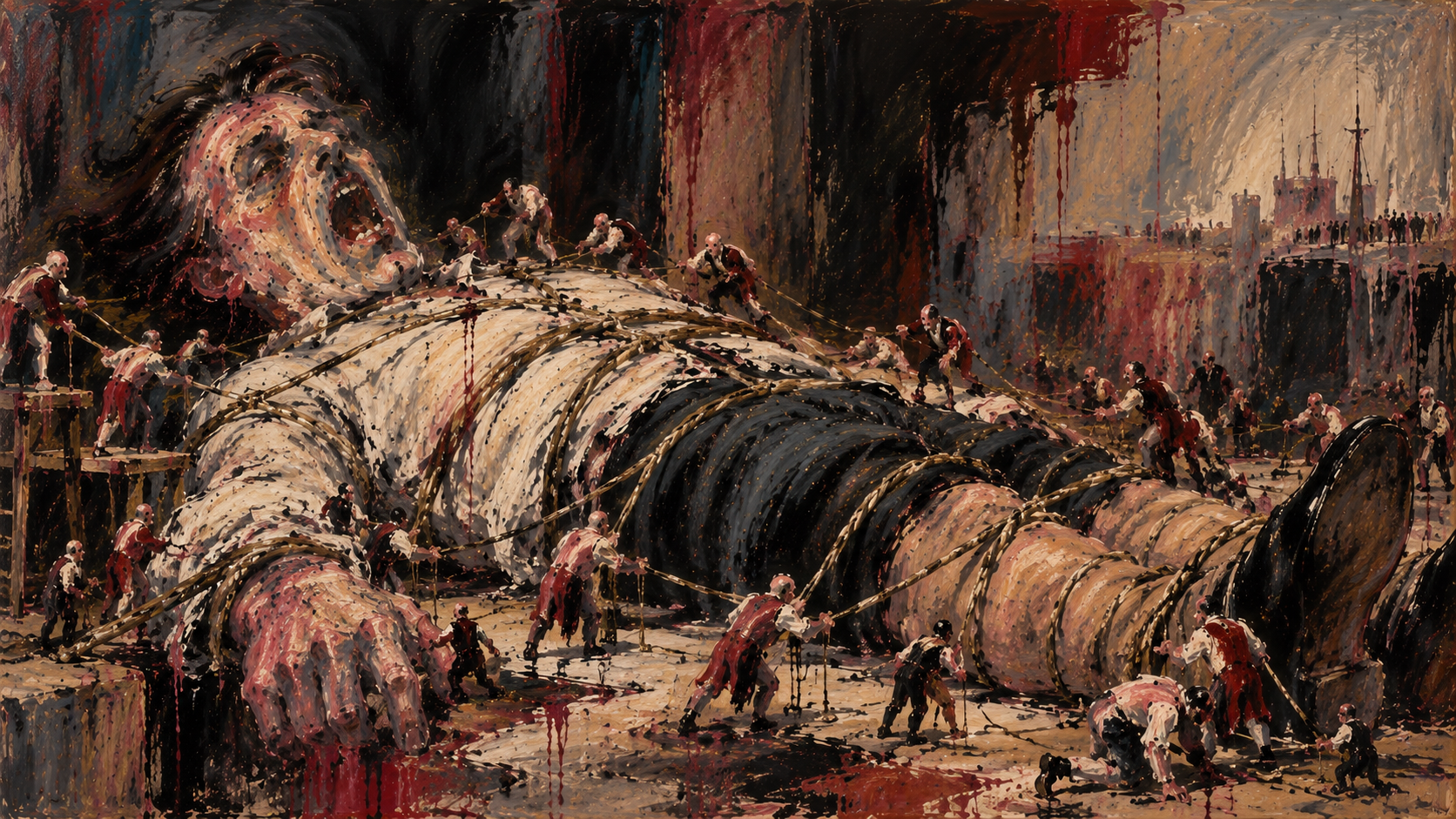
Imagine Gulliver’s capture by the Lilliputians, painted in Bacon’s distinctive expressionist style.
Gulliver lies helpless as dozens of miniature figures secure him with ropes. His enormous body dominates the composition, while his face is distorted into a scream.
What began as an illustration of physical scale becomes something altogether more psychological.
A giant, immensely powerful compared with his captors, is nevertheless completely helpless.
It’s precisely the sort of contradiction that Bacon’s artistic language could explore.
The Dublin Connection
Beyond their shared anniversary, Jonathan Swift and Francis Bacon have another connection: both were born in Dublin.
Swift was born in 1667, when Ireland was under English rule. Bacon arrived in 1909, during the final decades before Irish independence.
Their artistic worlds could hardly have been more different, yet both explored uncomfortable aspects of the human condition.
Swift used satire and imaginary journeys. Bacon used paint, distortion and the human figure.
Both challenged their audiences to see the world differently.
The Link Salad
Three hundred years after Gulliver first encountered the Lilliputians, we’ve imagined what might have happened if Francis Bacon had been there to paint the scene.
Two anniversaries, one city and two very different artistic approaches to human vulnerability.
Sometimes the smallest connections produce the biggest pictures.