
What connects one of the most disastrous cavalry charges in British military history with one of the twentieth century’s greatest painters?
The answer is 25 October.
25 October 1854 — The Charge of the Light Brigade
During the Crimean War, approximately 670 British cavalrymen charged into the Valley of Death at the Battle of Balaclava.
A misunderstanding of orders sent the Light Brigade towards Russian artillery positions, exposing the cavalry to devastating fire.
The charge became famous not for its military success, but for the extraordinary courage of the soldiers who carried it out.
Alfred, Lord Tennyson immortalised the event in his poem The Charge of the Light Brigade, published later that year.
His words transformed a military disaster into one of the most enduring passages of Victorian poetry.
25 October 1881 — Pablo Picasso Is Born
Exactly 27 years later, Pablo Picasso was born in Málaga, Spain.
Picasso would become one of the most influential artists of the twentieth century, helping to develop Cubism and fundamentally changing how artists represented the world.
In 1937, he created Guernica, his monumental response to the bombing of the Basque town during the Spanish Civil War.
Painted entirely in black, white and grey, Guernica depicts the anguish and devastation of warfare through distorted human figures and animals.
Among its most striking images is a horse, its head raised and mouth open in apparent agony.
🐎 The Connection — Picasso’s Light Brigade
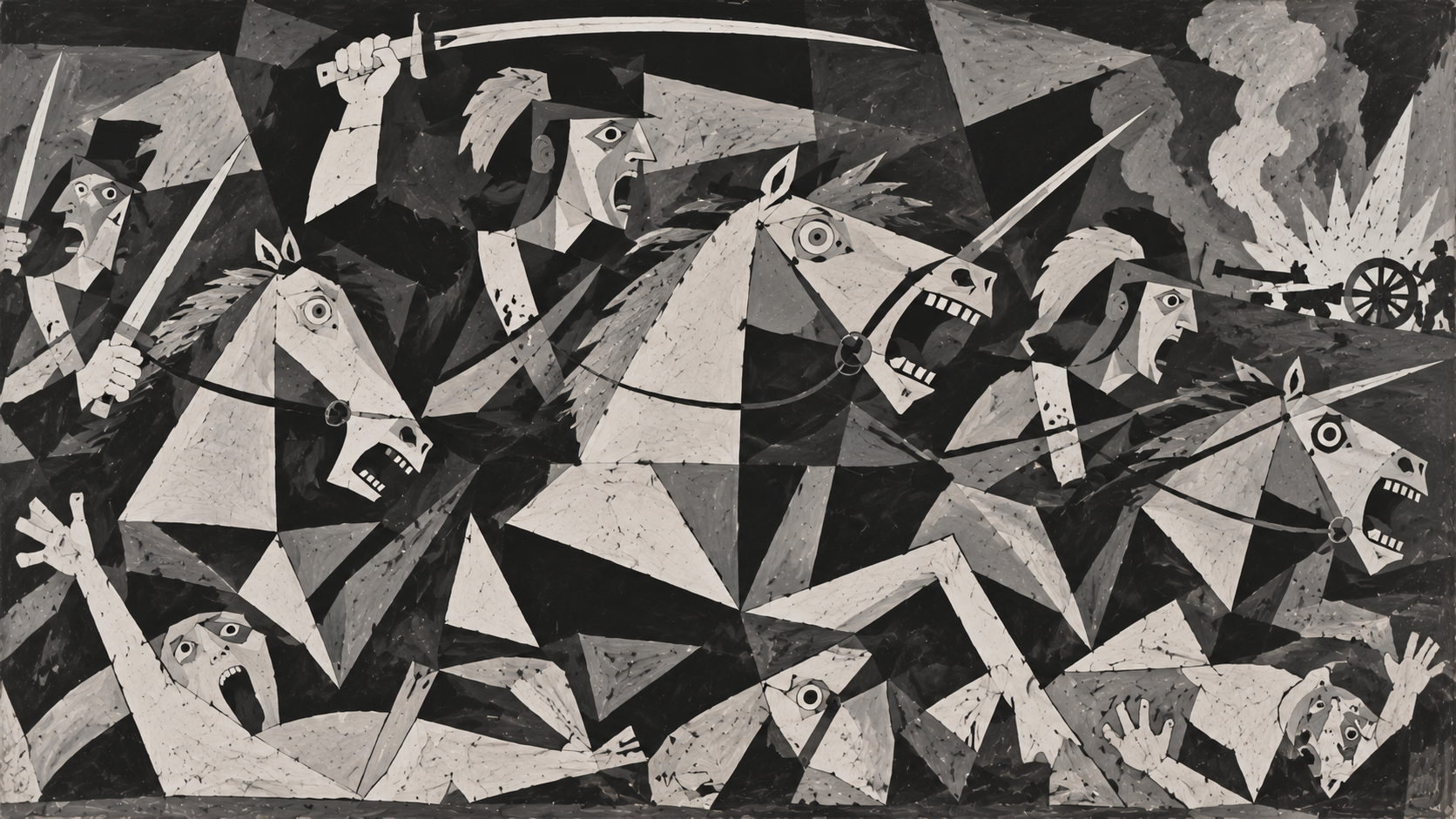
What if Picasso had painted the Charge of the Light Brigade?
Our imaginary painting brings together two events sharing the same calendar date.
Tennyson’s cavalrymen become Picasso’s fractured figures. Horses and riders are transformed into distorted shapes, their expressions conveying terror, confusion and determination.
The result is a collision of Victorian poetry and twentieth-century modernism.
Tennyson commemorated the courage of soldiers caught in a disastrous military operation.
Picasso exposed the suffering and destruction caused by war.
Both used art to ensure that the human consequences of conflict would not be forgotten.