
Gandhi’s Wheels 🕊️📺🇮🇳
Two men, two anniversaries, three wheels and a remarkable journey from Indian independence to modern television.
🕊️ 1. Gandhi’s Birthday — 2 October 1869
On 2 October 1869, Mohandas Karamchand Gandhi was born in Porbandar, India.
He would become one of the internationally recognised figures of the twentieth century, helping lead India’s struggle for independence from British rule through his philosophy of satyagraha, or non-violent resistance.
His campaigns included the famous Salt March of 1930, which challenged British taxation and colonial authority through peaceful civil disobedience.
Today, his birthday is commemorated internationally. In 2007, the United Nations designated 2 October as the International Day of Non-Violence.
But what could Gandhi possibly have in common with a Scottish inventor experimenting with electrical equipment in a London laboratory?
The answer lies partly in a shared date — and partly in a rather unexpected piece of machinery.
📺 2. John Logie Baird — 2 October 1925
Exactly 56 years after Gandhi’s birth, John Logie Baird achieved a major breakthrough in the development of television.
Working at 22 Frith Street in Soho, London, Baird successfully transmitted a recognisable television image containing shades of grey.
His early experiments involved a ventriloquist’s dummy named Stooky Bill, whose head could withstand the intense heat produced by the lighting equipment.
Baird subsequently persuaded a young office worker, William Taynton, to stand in front of his apparatus, allowing him to transmit a recognisable human face.
The images were tiny, flickering and primitive by modern standards.
Nevertheless, the breakthrough of 2 October 1925 represented an important milestone in television’s development.
Baird’s first formal public demonstration followed on 26 January 1926.
And here’s the interesting part.
Baird’s television depended on a spinning disc.
His mechanical scanning system used rapidly rotating discs to convert variations in light into electrical signals and reconstruct the resulting images.
Eventually, this technology would be replaced by electronic television, using cathode-ray tubes rather than mechanical scanning discs.
Cathode-ray televisions subsequently evolved through colour broadcasting, digital technology and flat-panel displays.
Today, moving pictures reach us through television screens, laptops, tablets and smartphones.
But the underlying ambition remains familiar: transmitting images so that distant events can be seen elsewhere.
🧵 3. Gandhi’s Spinning Wheel — The Charkha
Now we arrive at our third link.
One of Gandhi’s most recognisable symbols was the charkha, a traditional Indian spinning wheel used to turn cotton into yarn.
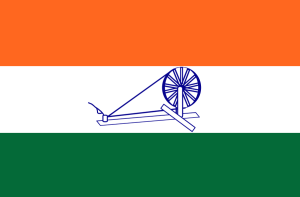
Gandhi promoted hand-spinning and the wearing of khadi, or homespun cloth, as part of the campaign for Indian economic self-reliance.
Rather than depending on imported British textiles, Indians could produce their own cloth.
The spinning wheel therefore represented more than a simple machine. It became associated with independence, dignity, productive work and the empowerment of ordinary people.
Gandhi was not opposed to all technology. He questioned industrial systems that concentrated economic power or displaced workers without providing alternative livelihoods.
He favoured simple machines that could be operated, repaired and maintained within local communities.
And that gives us a particularly satisfying connection.
Gandhi’s charkha and Baird’s television scanning disc both depended on rotation.
One transformed cotton into yarn. The other helped transform light into moving pictures.
They were entirely different technologies, serving entirely different purposes, yet the common mechanical principle provides a connection between them.
And the story of Gandhi’s wheel does not end there.
🇮🇳 4. Indian Independence and the Ashoka Chakra
On 15 August 1947, India finally achieved independence from British rule.
Partition also created Pakistan, initially comprising western and eastern territories separated by India. The eastern territory would eventually become Bangladesh in 1971.
But Gandhi did not become India’s first Prime Minister.
That position went to Jawaharlal Nehru, who had led the interim government before independence and became the first head of government of independent India.
Although Gandhi had been central to the independence movement, he did not seek a position in the new government.
Instead, he continued working outside formal political office, concentrating on communal harmony, village development and the practical application of non-violence.
Remarkably, he wasn’t even in New Delhi for the independence celebrations.
He was in Calcutta (now Kolkata), attempting to ease the religious tensions and violence accompanying Partition.
On Independence Day itself, Gandhi observed a fast, prayed and continued spinning cotton.
While Nehru was assuming leadership of the new nation, Gandhi was still practising the principles he had advocated throughout the independence movement.
And the spinning wheel had already acquired another important role.
Earlier flags of the Indian independence movement had featured Gandhi’s charkha.
However, on 22 July 1947, India’s Constituent Assembly adopted a new national flag incorporating a different wheel.
This was the Ashoka Chakra, a navy-blue wheel with 24 spokes, placed in the centre of the white band of India’s saffron, white and green tricolour.
Its design derives from the ancient Wheel of Dharma associated with Emperor Ashoka and the Buddhist heritage of the Indian subcontinent.
But the connection with Gandhi was intentional.
When introducing the national flag, Nehru explained that the new wheel would preserve the symbolism of the charkha while replacing its more complicated depiction.
The Ashoka Chakra became a national symbol, associated with law, moral order, movement and progress.
It was not simply another version of Gandhi’s spinning machine, but it preserved a deliberate connection to that earlier emblem of independence.
And that brings us to a remarkable modern contrast.
India, whose independence movement made a simple spinning wheel so recognisable, has become an international centre for information technology.
Bengaluru, frequently described as India’s Silicon Valley, has developed into a major centre of software engineering, electronics and digital innovation.
From hand-spun cotton to global software development, the country’s technological landscape has changed enormously.
Yet the wheel remains at the centre of its national flag.
🎬 5. “Gandhi” — The Film That Brought His Story to the Screen
Our fifth link takes us to 1982 and the release of Richard Attenborough’s biographical film Gandhi.
Starring Ben Kingsley in the title role, the film follows Gandhi’s life from his experiences in South Africa through India’s independence movement and ultimately to his assassination in 1948.
Its distinguished international cast included Rohini Hattangadi, Roshan Seth, Candice Bergen, Edward Fox, John Gielgud, Trevor Howard, Martin Sheen and Ian Charleson.
At the 1983 Academy Awards, Gandhi received eleven nominations and won eight Oscars, including Best Picture, Best Director and Best Actor.
The film introduced Gandhi’s story to new generations through cinema and, subsequently, television and home viewing.
It also connects to an extensive network of other films through its actors and director.
Richard Attenborough, for example, would later appear in Jurassic Park, while Ian Charleson had previously starred in Chariots of Fire.
And the technology that enabled audiences to watch Gandhi’s story had its own history stretching back to Baird’s experiments in 1925.
Gandhi was assassinated on 30 January 1948, and his funeral was filmed for cinema newsreels.
India itself did not begin television broadcasting until 15 September 1959, so the footage of Gandhi’s funeral should not be confused with a contemporary Indian television broadcast.
Nevertheless, film and television have played important roles in documenting and communicating Gandhi’s life and legacy.
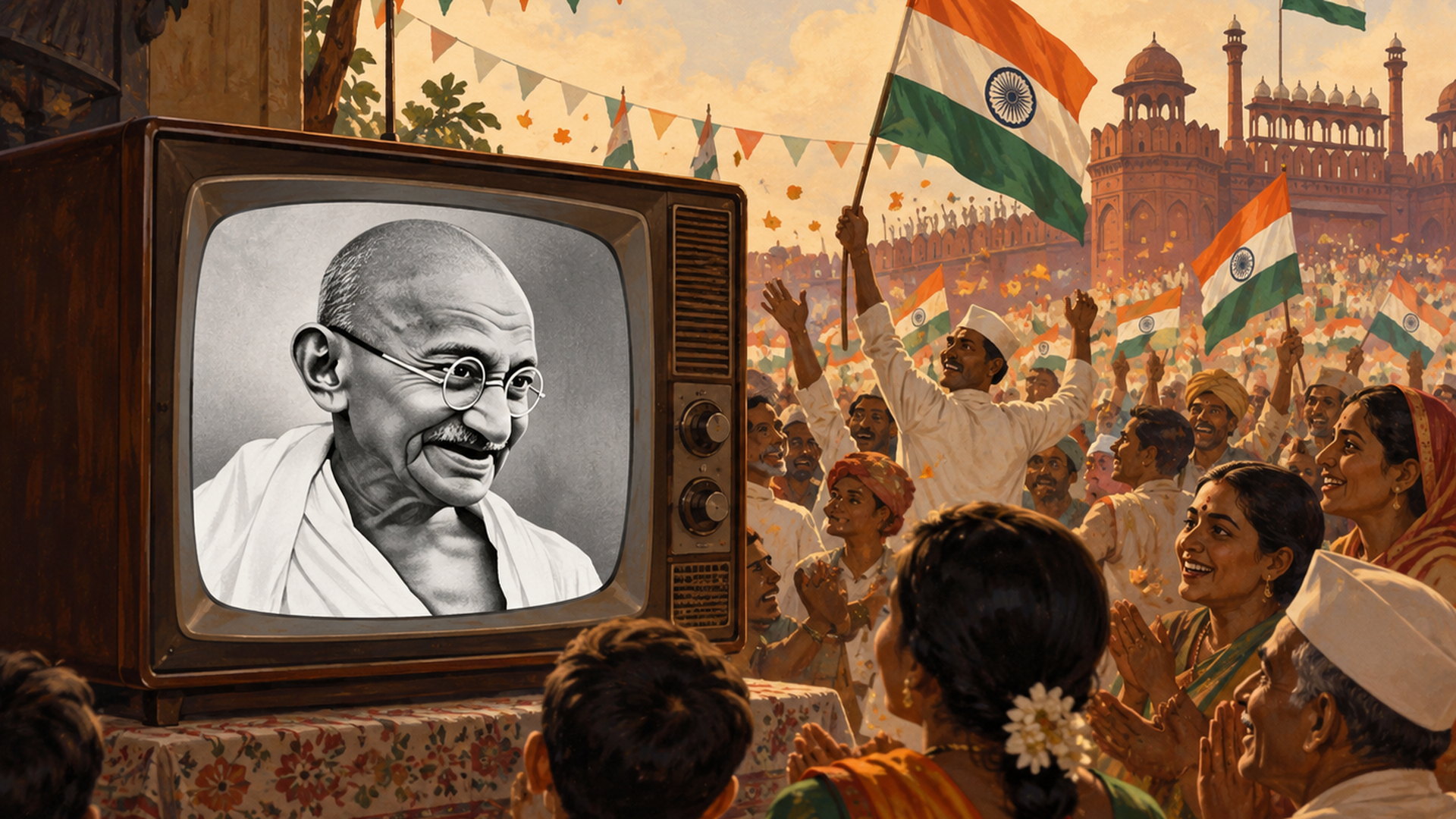
Our accompanying illustration of Gandhi appearing on a vintage television against the backdrop of Indian independence celebrations is therefore deliberately symbolic, bringing together events that occurred at different moments in history.