
There are two ways of spreading light: to be the candle or the mirror that reflects it.” — Edith Wharton
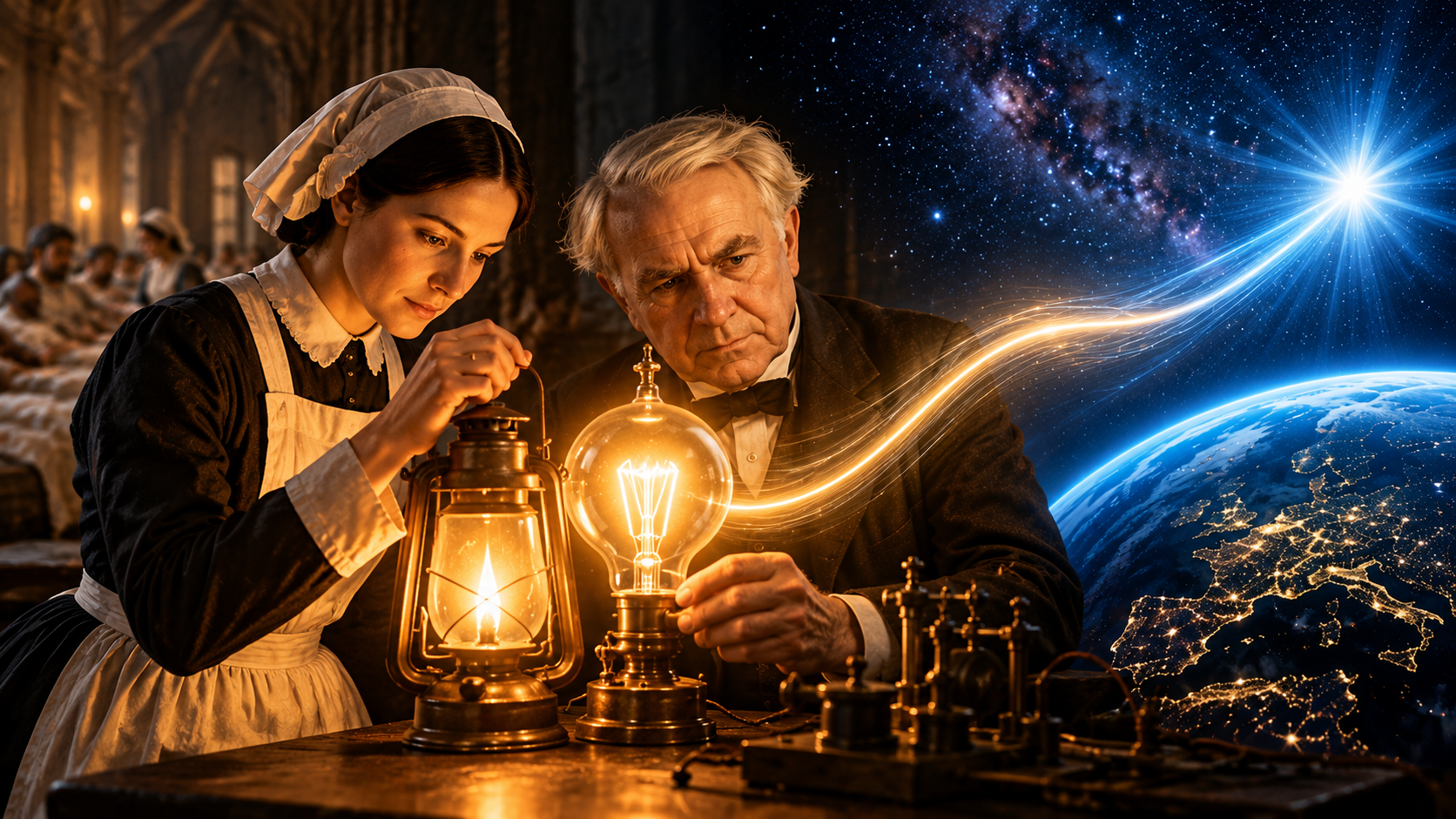
What connects a Victorian nurse, an American inventor and the speed of light?
The answer is 21 October — a date that takes us from the battlefields of the Crimean War to the birth of practical electric lighting, and ultimately to the very definition of a metre.
Three anniversaries, spanning 129 years, connected by one remarkable theme: light.
1854 — The Lady with the Lamp
On 21 October 1854, Florence Nightingale departed Britain with a party of nurses bound for the Crimean War.
Their destination was the military hospital at Scutari, near Constantinople (modern Istanbul), where British soldiers were suffering from appalling conditions, disease and inadequate medical care.
Nightingale would become famous for her tireless efforts to improve nursing and hospital sanitation.
During her nighttime rounds, she carried a lamp as she checked on wounded soldiers, earning the enduring nickname the Lady with the Lamp.
Her light became a symbol of compassion, reassurance and the transformation of nursing.
But exactly 25 years after her departure, another kind of lamp was making history.
1879 — Edison Lights the Way
On 21 October 1879, Thomas Edison and his team achieved an important breakthrough in the development of practical incandescent electric lighting.
At his Menlo Park laboratory in New Jersey, Edison was experimenting with carbon filaments inside evacuated glass bulbs.
The experiments helped demonstrate that electric lamps could provide sustained illumination, paving the way for commercially practical lighting systems.
Edison did not invent the first electric light bulb. Other inventors, including Britain’s Joseph Swan, had already made important contributions.
Nevertheless, Edison’s work helped turn electric lighting into a technology capable of transforming homes, workplaces and cities.
Where Nightingale’s lamp had illuminated hospital wards, Edison’s electric lamp promised to illuminate the modern world.
And the story doesn’t end there.
1983 — Measuring the Universe with Light
On 21 October 1983, the 17th General Conference on Weights and Measures adopted a new definition of the metre.
Instead of relying on a physical measuring bar or a particular wavelength of radiation, the metre would now be defined using something fundamental to the universe itself: the speed of light in a vacuum.
One metre became the distance travelled by light in a vacuum during 1/299,792,458 of a second.
The speed of light was fixed at exactly 299,792,458 metres per second.
Light was no longer simply something we used to see the world. It had become fundamental to how we measured it.
Three Lights, One Date
And here is our Link Salad:
- 21 October 1854: Florence Nightingale departs for the Crimea — light as a symbol of care.
- 21 October 1879: Edison’s incandescent lamp experiments — light as practical technology.
- 21 October 1983: The metre is redefined — light as a universal measuring standard.
The intervals are particularly satisfying: 25 years, then 104 years, making 129 years from beginning to end.
The first lamp offered comfort to individuals. The second helped illuminate entire cities. The third takes us beyond the Earth, to the fundamental laws of physics.
Of course, light has always travelled at the same speed in a vacuum. What changed in 1983 was our decision to use that constant to define distance.
And that is what makes today’s connection so appealing.
A simple lamp becomes an electric bulb. An electric bulb leads us to the physics of light. And the physics of light leads us to the measurement of the universe.