
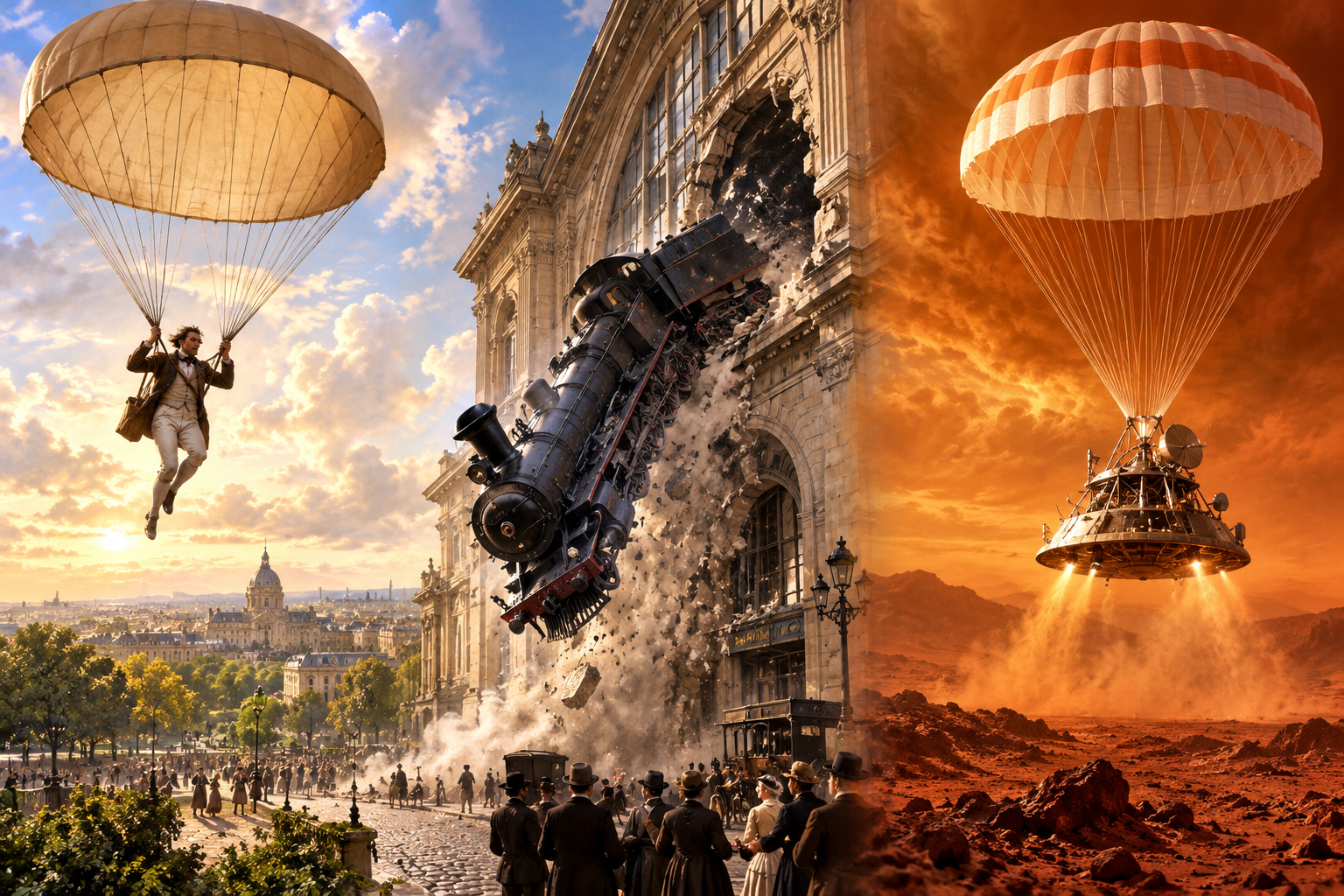
What could possibly connect a pioneering French parachutist, a spectacular railway accident in Paris and a Soviet spacecraft landing on Venus?
The answer is gravity — and the remarkable coincidence that all three events happened on 22 October.
Our story begins in Paris, travels through one of the most extraordinary accidents in railway history, and ends on the surface of another planet.
1797 — Taking the Plunge
On 22 October 1797, André-Jacques Garnerin made the first recorded high-altitude parachute descent from a balloon, above the Parc Monceau in Paris.
Suspended in a basket beneath a silk canopy, Garnerin detached himself from his hydrogen balloon and began falling towards the ground.
His parachute worked, but the descent was far from smooth. Without a vent to stabilise the canopy, the basket swung alarmingly from side to side.
Nevertheless, Garnerin landed safely, demonstrating that gravity could be resisted through the simple principle of air resistance.
1895 — The Train That Fell Out of a Station
Exactly 98 years later, on 22 October 1895, gravity played a rather less welcome role in Paris.
An express train arriving from Granville failed to stop at Gare Montparnasse.
The locomotive smashed through the buffer stops, crossed the station concourse, broke through the exterior wall and plunged onto the street below.
The resulting photograph, showing the enormous steam locomotive hanging almost vertically from the station building, became one of the most extraordinary images in railway history.
Tragically, a woman in the street was killed by falling masonry.
Unlike Garnerin’s carefully planned descent, this was an uncontrolled fall with fatal consequences.
1975 — Falling Towards Another Planet
Another 80 years passed.
On 22 October 1975, the Soviet spacecraft Venera 9 successfully landed on Venus.
After travelling millions of kilometres through space, its descent module entered the planet’s dense atmosphere, deploying a parachute system during its journey towards the surface.
The parachutes were part of a carefully engineered descent sequence designed to cope with one of the most hostile environments in the Solar System.
Venera 9 survived the landing and transmitted the first photograph ever taken from the surface of another planet.
It continued operating for approximately 53 minutes, sending back unprecedented views of the rocky Venusian landscape.
From a silk parachute over Paris to a sophisticated spacecraft descending through the atmosphere of Venus, the same fundamental principles of gravity and atmospheric resistance were at work.
A Hollywood Connection — Back to the Future!
And there’s one final coincidence.
Christopher Lloyd was born on 22 October 1938.
Lloyd is, of course, famous for playing Doc Brown in Back to the Future.
In Back to the Future Part III, a steam locomotive pushes the DeLorean towards the speed needed for time travel, before plunging off an unfinished railway bridge into a ravine.
Another falling locomotive!
And another connection to 22 October, courtesy of the actor’s birthday.
Three Descents, One Date
Our three historical events couldn’t be more different:
- 1797: A man deliberately falls towards Earth and survives.
- 1895: A locomotive accidentally falls from a Paris railway station.
- 1975: A spacecraft descends onto Venus and sends pictures home.
Two events take place in Paris, while the third carries us across the Solar System.
And all three happened on exactly the same calendar date.
Gravity is universal. The circumstances, consequences and achievements are anything but.
That’s the gravity of the situation.