
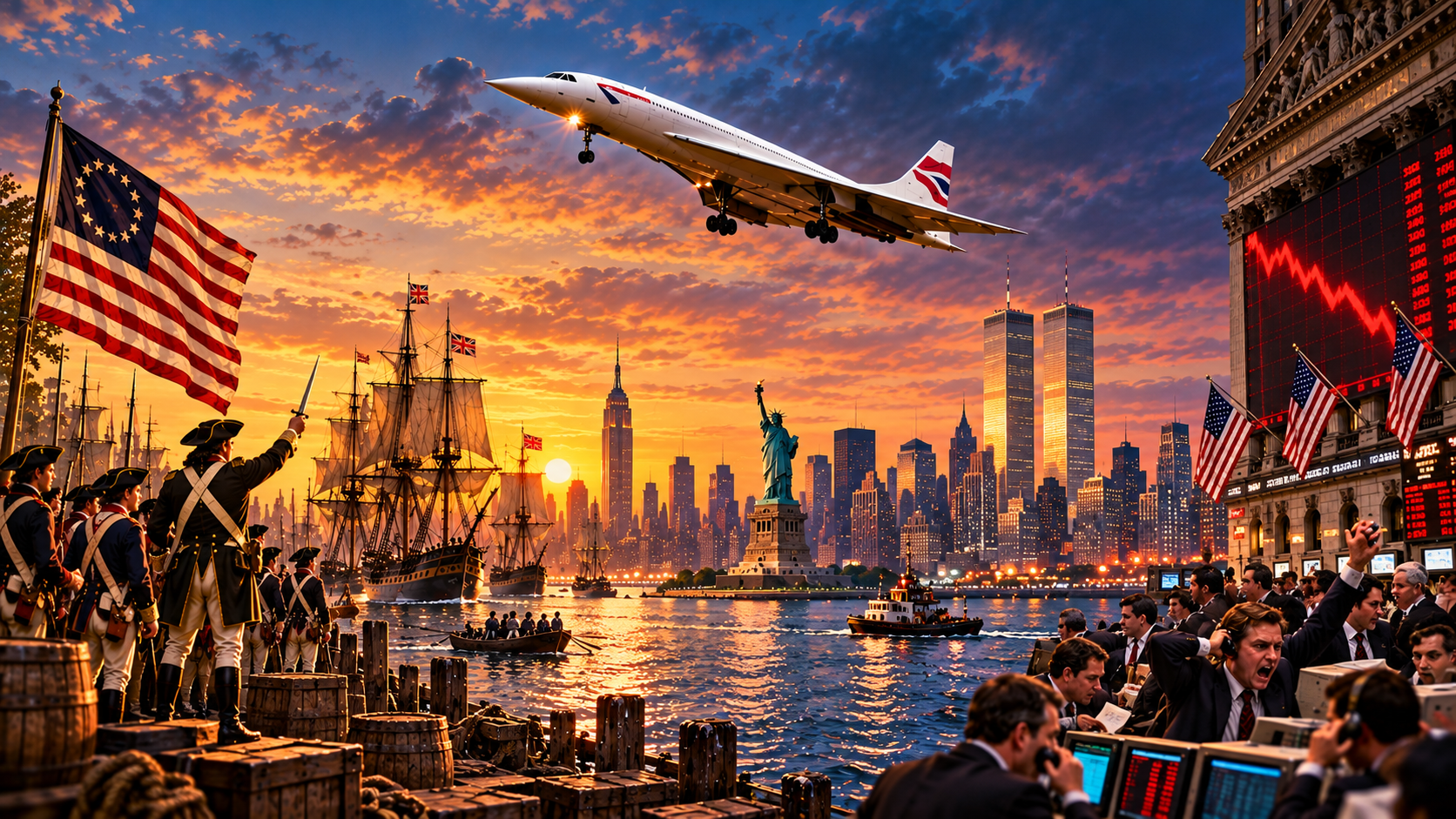
New York, Thrice! Three events, three centuries, one extraordinary date.
Monday 19 October 2026 🗽 ✈️ 📉
What connects a British naval expedition during the American Revolutionary War, the world’s most famous supersonic passenger aircraft, and the biggest one-day percentage crash in Wall Street history?
The answer is New York City — and 19 October.
Today we’re exploring three remarkable events that occurred on exactly the same date, in 1781, 1977 and 1987.
Our journey takes us from eighteenth-century sailing ships to twentieth-century aviation, before ending in the financial turmoil of Black Monday.
And each event has a distinctly New York connection.
🇺🇸 1781 — The Ships That Sailed Too Late
On 19 October 1781, British General Lord Cornwallis formally surrendered his army at Yorktown, Virginia, to American and French forces.
The surrender was one of the decisive moments of the American Revolutionary War, effectively ending major British military operations in the conflict.
But what was happening in New York that very same day?
Sir Henry Clinton, the British commander-in-chief in North America, had assembled a relief expedition to rescue Cornwallis’s trapped army.
The expedition finally sailed from New York on 19 October 1781.
Unfortunately for the British, that was precisely the day Cornwallis surrendered.
The reinforcements were already too late.
It’s an extraordinary historical coincidence: on the same day that one British army was surrendering at Yorktown, another British force was setting sail from New York to save it.
The ships eventually returned without achieving their mission.
New York was therefore directly connected to the surrender, even though the battlefield lay hundreds of miles away in Virginia.
✈️ 1977 — Concorde Comes to New York
Fast-forward 196 years, to 19 October 1977.
This time, something was arriving in New York rather than departing.
Concorde made its landmark first landing at John F. Kennedy International Airport, following years of controversy surrounding the aircraft’s noise and environmental impact.
The Anglo-French supersonic airliner represented an extraordinary technological achievement.
Flying at more than twice the speed of sound, Concorde could cross the Atlantic in roughly half the time required by conventional passenger aircraft.
Scheduled commercial services between Europe and New York began on 22 November 1977.
For a city already synonymous with ambition, commerce and international travel, Concorde became another symbol of modernity.
New York had entered the supersonic age.
📉 1987 — Black Monday
Exactly ten years later, on Monday 19 October 1987, New York witnessed a very different kind of record-breaking speed.
The Dow Jones Industrial Average plunged 22.6% in a single trading session.
It remains the largest one-day percentage fall in the index’s history.
The event became known as Black Monday.
Unlike Concorde’s spectacular arrival, this was an occasion nobody wanted to celebrate.
Panic spread through financial markets, with stock exchanges around the world experiencing dramatic losses.
The crash exposed vulnerabilities in increasingly interconnected financial systems, including the effects of computer-driven trading strategies.
Once again, New York was at the centre of an event with international consequences.